Don’t be put off by the cover image, this isn’t a deep drill down into musicology or music theory. Well, a bit maybe although I’ll try to swerve Greek lyres and the Catholic church as best I can.
Every guitar forum on Facebook has an argument about ‘modes’. Someone asks a perfectly reasonable question about modes, and within the hour there are two hundred competing and heated comments.
I don’t really get it because modes are relatively simple, I think.
This post started with a conversation on Threads. Someone asked whether there were any useful YouTube resources on modes. I chipped in with what I thought was a sensible answer regarding modes and how to think about them, braced myself for the usual pile on, which actually didn’t happen as it turned out. Other contributors actually agreed with me, which on a thread about modes and scales is close to a miracle!
So this post is pretty much that answer, expanded out with a bit more detail than the 500 characters Threads limits you to posting.
Where they actually came from
OK, this is my understanding of the musicology bit.
Modes are old. Much older than major and minor scales. Medieval church music was organised entirely around them, a set of scales all built from the same seven notes, each with its own character, each used for different kinds of chanting.
The names (Dorian, Phrygian, Lydian and the rest) were borrowed from ancient Greek music, and actually borrowed badly, believe it or not. The medieval theorists attached them to the wrong scales, so what the Greeks called Dorian isn’t what we call Dorian. The naming has been muddled from the very beginning, which feels more appropriate given how the bunfights on Facebook go.
Then somewhere around the 1600s, two of the modes won. Ionian became “the major scale”, Aeolian became “the natural minor scale”, and the other five were quietly demoted.
How they got from the monastery to the guitar forum is mostly a jazz story. Modal jazz arrived in the late 1950s. Kind of Blue by Miles Davis is, more or less, a modes record, fusion players carried this vocabulary into rock, and then the 80s shred era got hold of it. Somewhere around then, “you should learn your modes, man, in all positions!” became the mark of the serious player, and the guitar magazines and instructional videos from that time did the rest. Every argument on every forum today is a direct descendant of that sentence. (This is not a hair rock guitar blog btw, but here we are.)
Why there’s no ‘black note’ between B and C
Music theory alert, but bear with me!
If you look at a piano keyboard (it’s easier to visualise than looking at a fretboard), you’ll notice that there’s no black note between B and C, and none between E and F.
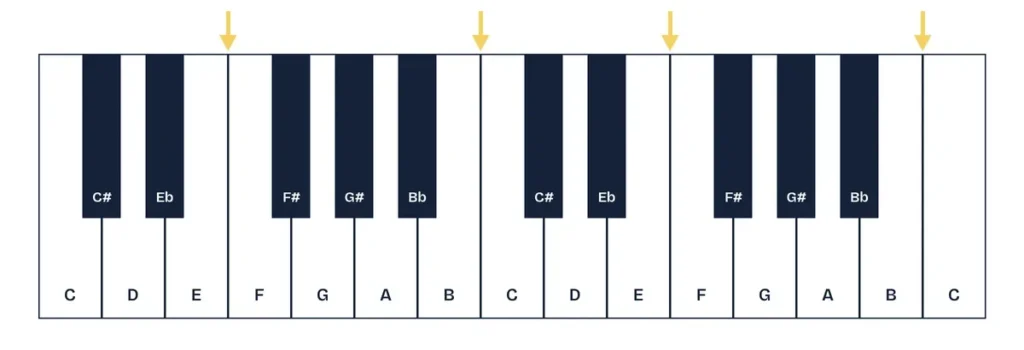
It looks like a mistake, or at least an odd design decision. It isn’t. The white notes are the original seven-note scale, the one all that church music was built on, and the black notes were bolted on, or inserted rather, afterwards as musicians wanted the in-between notes.
And by playing all the white notes in order, starting from C (i.e. the C major scale) you’ll notice that the intervals aren’t evenly spaced, because of these missing black notes.

That uneven pattern, or mixed bag of tones and semitones, is the entire mystery of modes. Start the pattern from C and the semitones land in one place: that’s the major scale. Start it from D and they land somewhere else: that’s Dorian. And whereabouts in a scale the semitones sit is what gives each mode its sound or ‘mood’.

It also explains the major/minor split that confuses everyone. If the semitones land so that the third note of the scale is a minor third (3 frets ahead of the first or root note), the mode sounds minor: Dorian, Phrygian, Aeolian. If the third comes out major (4 frets ahead), it sounds major: Ionian, Lydian, Mixolydian.
As for Locrian, (the weird sounding last mode you can create using this system of cycling through or reconfiguring a major scale), ignore it, everyone else does.
Julie Andrews
“Doe, a deer, a female deer Ray, a drop of golden sun Me, a name I call myself Far, a long, long way to run Sew, a needle pulling thread La, a note to follow sew Tea, a drink with jam and bread That will bring us back to Do (oh-oh-oh)”
OK, maybe this is an easier way to understand how you can create modes. I’ll have to replace the “That will bring us back to Do (oh-oh-oh)” bit with a bog standard ‘Doe a female deer’ to get it to work though. Also, the distance (or musical interval) between Me and Far, and also Tea and the second Doe is a semitone, 1 fret, not a 2 fret ‘whole-tone’.
So this is how you would make a Dorian scale, which is a minor scale, not major.
Ray, a drop of golden sun Me, a name I call myself Far, a long, long way to run Sew, a needle pulling thread La, a note to follow sew Tea, a drink with jam and bread Doe, a deer, a female deer That will bring us back to Ray (ay-ay-ay)
The explanation that doesn’t work
Which brings us to the standard forum answer: “Dorian is just the C major scale, but starting on D, and ending on D an octave higher.”
This is true. As you’ve just seen, it’s historically exactly what happened. It’s also a useless explanation.
How you should think of, and use modes
Firstly, give each one your own nickname. Mine are:
- Ionian: Major, the Happy Happy Happy, Joy Joy Joy scale
- Dorian: the Funk scale
- Phrygian: the Dark Metal scale
- Lydian: the Super Bright Makes You Sound Like Steve Vai scale
- Mixolydian: the Hippy Dippy scale
- Aeolian: Sad and folky PJ Harvey scale
- Locrian: Weird
Classifying modes by feeling (or mode = ‘mood’) is the oldest approach there is, it just took a 2,400 year detour through various classifications before ending up on a Facebook guitar forum.
(Apparently, Plato said Dorian makes you steadfast, I say it makes you sound funky.)
Secondly, learn them from the same root. Not C major, then D Dorian, then E Phrygian etc.
Play C major, then C Dorian, then C Phrygian, then C Lydian, etc. Now you can hear and recognise their character. As guitarists, we learn scale shapes, right? So play C Phrygian, B Phrygian, Bb Phrygian etc, (or noodle away on the theme from Jaws, if you like). Move away from them being derived from re-arranging major scales, and learn their shape and sound.
After a while, when you relate them all to the same key, you start to recognise which notes are altered in comparison to the major scale. Mixolydian is the major scale with the 7th note of the major scale flattened for example, play it over a droning root note and achieve enlightenment.
So why all the bunfights?
Because most of the arguments are between people who agree with each other. One explains it with parent scales, another with intervals. Each is convinced the others are dangerously wrong. The original poster who asked the innocent question takes one look and decides modes are beyond them.
They aren’t. They are just other scales to learn the shapes for. There’s probably only a few you’d ever use frequently. If you were in a Funkadelic tribute band (and that would be awesome) then you are going to be playing the Dorian scale, no question. If you’re writing a ballad about your sweetheart being lost at sea, then it’ll either be the natural minor / Aeolian scale, or if it’s particularly depressing, the Phrygian scale.
My ‘Steve Vai’ classification comes from me having to learn PiL’s Rise for the Expletives and the bridge parts have Steve Vai playing short lines in E Lydian.
And yes, if you post any of this on a guitar forum somewhere, someone will be along shortly to explain that this is all wrong.