During May 2016, I was playing in a retro ‘Americana’ focused band called the Moonraiders, based in North Lincolnshire. I knew I needed to invest in a decent amp to suit the music, and I’d started to see reviews of the Kemper Profiler online. It looks like a green toaster (their now given nickname) or like an old radio set from the 1930’s. Then I unwittingly heard one being played at a gig in a small pub in Lincoln, the Tap and Spile.
My view of the performance area was blocked by a series of columns (the Tap and Spile is now no longer in existence), but I could hear clearly enough, and what I could hear sounded to me like a beautiful vintage Silverface Fender amp. Instead of course, it was the Kemper, balanced somewhat precariously on a cheap looking monitor speaker. That was that, and after conversations with the guitarist, I ordered one from Andertons the very next day.
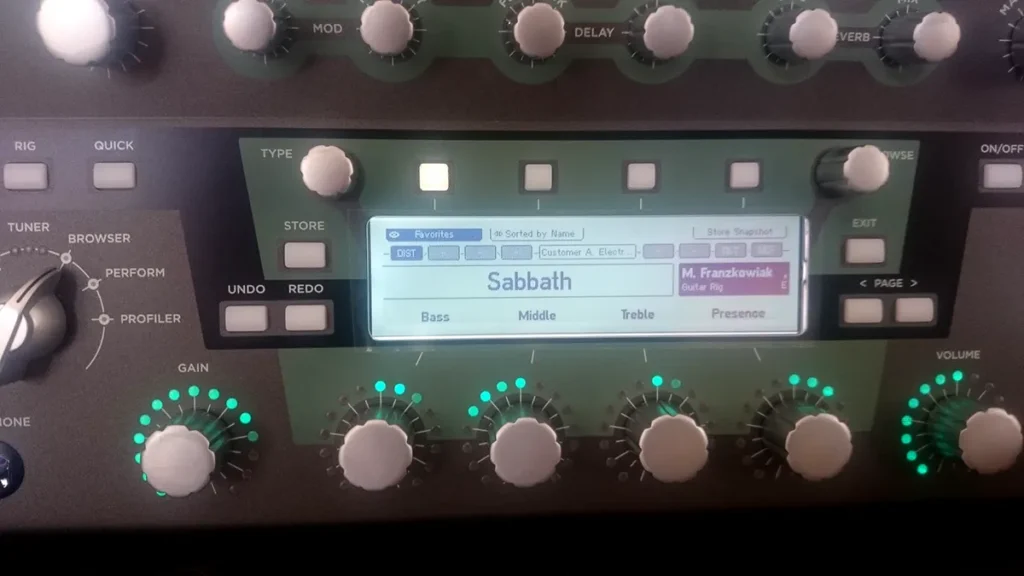
So what does it actually do?
It profiles real amplifiers. You connect it to an amp, run a signal through, and it captures not just the EQ but almost like the behaviour. There’s a large library of profiles available online, which means you can get a convincing approximation of pretty much any amp that’s ever existed, without owning any of them. I never actually profiled an amp myself, I just started downloading away, beautiful sounding Fender Deluxe profiles, Bassmans, Marshalls, 5150s, you name it.
Studio guitarists use this to their advantage in a specific way: get the amp sounding exactly right in the room, profile it immediately, then use the profile for the rest of the session. No risk of a mic stand getting kicked, no humidity changes, no wondering why it sounds slightly different after a break in proceedings.
Which is more useful than it sounds. I now play in a punk covers band (The Expletives, we’re exactly what you’d expect), and being able to switch between a cranked Marshall and something cleaner mid-set, without touching a physical amp, is not a small thing.
“Why have canned tuna when you can get fresh tuna?”
An online comment I received when evangelising about the Kemper, from someone who very much preferred valve amps.
The thing is, I’ve played through both valve and solid state amps most of my life until then. Valve amps sound wonderful under the right conditions, no question. They also run hot. When I was younger, a valve in my old Fender Pro Reverb overheated and set my bedroom curtains on fire. They’re heavy, very unversatile really, unless you’re a pedal freak, and they sound different every day due to factors that remain genuinely mysterious.
My back also isn’t what it was.
The Kemper sounds the same everywhere, every night. Whether that matters to you depends on what you’re doing, but for a regular gigging player it matters quite a lot.
Powered or unpowered?
The Kemper comes in both. The unpowered version goes direct to the PA or into a separate power amp. I bought the powered version (600W built in) specifically so I could keep using my battered old 2×10″ cab. I like air moving behind me on stage. Going direct into a PA sounds fine out front, and for a lot of players that’s entirely the point. But I find it harder to play without the physical push of a speaker behind me, with the tinnitus to match.
Switching it live
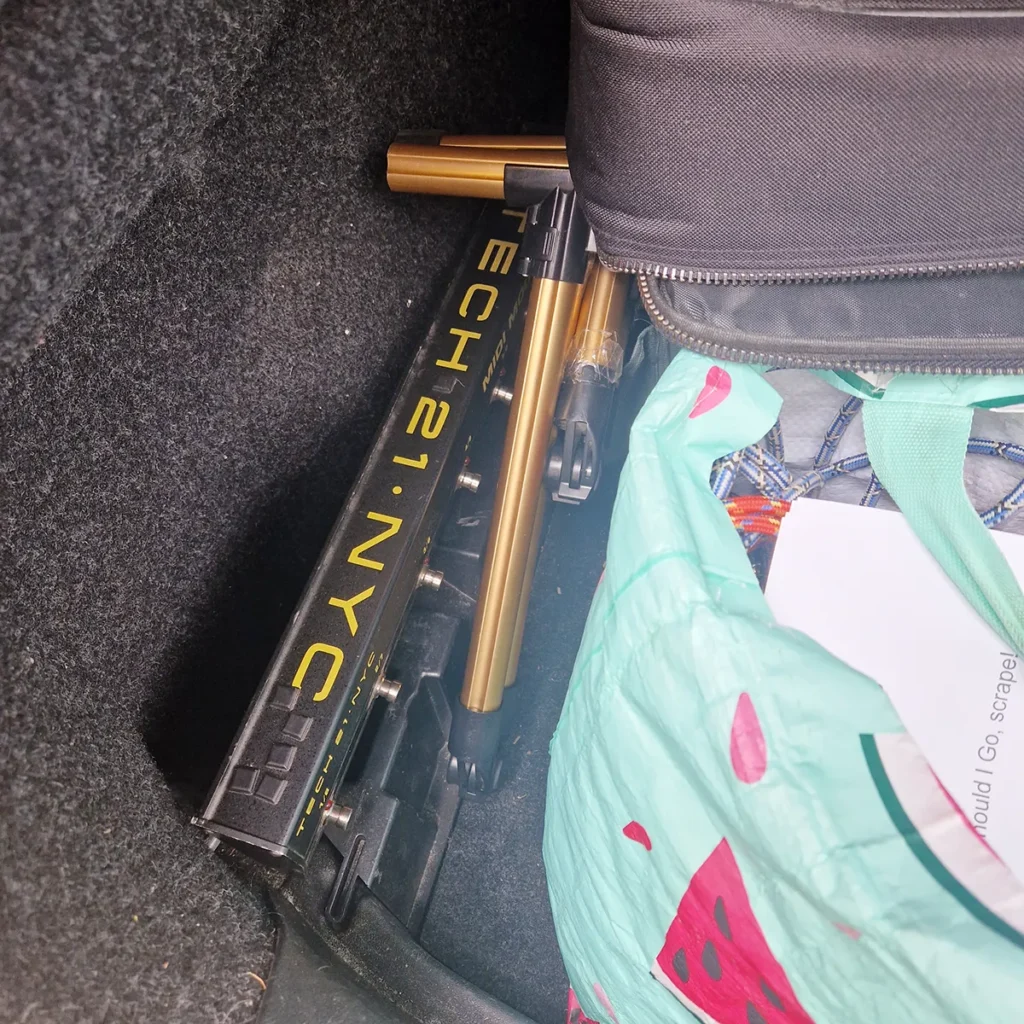
In performance mode, you can switch between 5 profiles, or individual amps, each with their own set of pre or post effect loops. For a while I was using a Tech 21 MIDI footswitch to change between profiles. It worked fine until the switch for program 1 got stuck, at which point I had to remap all my performance settings and shift everything from slots 1-5 to 2-5. Eventually my wife bought me the proper Kemper foot controller. Very grateful husband.
I still keep the old Tech 21 in the boot of the car with a MIDI cable, just in case. Specifically just in case Sean, the singer in The Expletives, stands on the fancy ethernet cable that connects the foot controller to the Kemper. (I worry about this every single gig to be honest.)
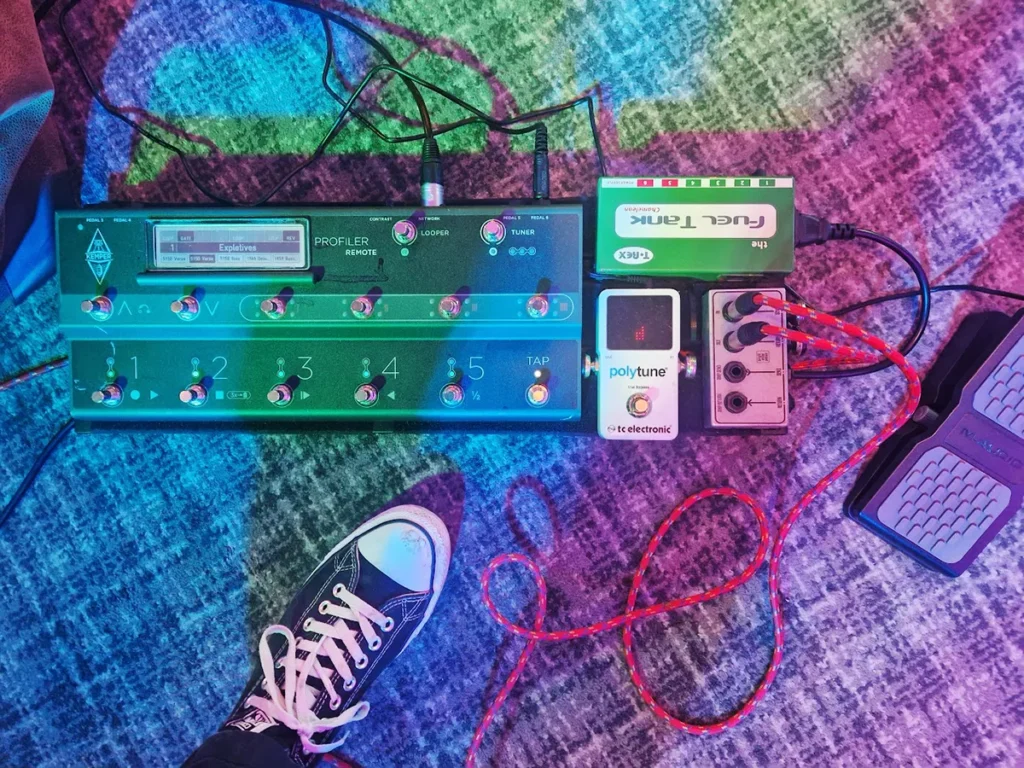
One other thing worth knowing, the (strobe) tuner display on the Kemper footswitch is not especially bright. And so, I still keep my trusty old pedalboard, albeit stripped back to a power supply, my trusty Polytune and a send and return junction box from Bright Onion.
Is it worth it?
It’s not cheap. It’s equivalent to a boutique valve amp, but with the ability to store and recall 128 boutique amps! Whether it’s worth it depends on what you need from it.
For a gigging player who wants consistent results without the variables of amp reliability, absolutely.
It’s also remarkably straightforward to use live once you’ve set it up. I was slightly apprehensive before I got one and I use it in a pretty bullet-proof, dumb way. My ‘lead guitar sound’ is usually just a copy of the rhythm amp, but way louder with more prominent mids and delay. On stage it just behaves like an amp. Depending on whatever amp you’ve downloaded, it will feedback like, well, a normal cranked amp. You turn it on, you play. And try not to think about the ethernet cable, that’s under your feet.
One thing I will say: I’ve barely scratched the surface of what it can actually do. We cover Gary Numan’s Cars with The Expletives, and I created a patch that makes the guitar sound like the synth playing the top line melody, and it draws a lot of questions after the show. (The previous guitarist didn’t do this. He didn’t have a Kemper.) That’s one small corner of what the thing is capable of. The effects, some of them genuinely ethereal, even if they are digital, are a whole other area I haven’t properly got into yet (even after ten years!), and no doubt will feature as another post in the future.